
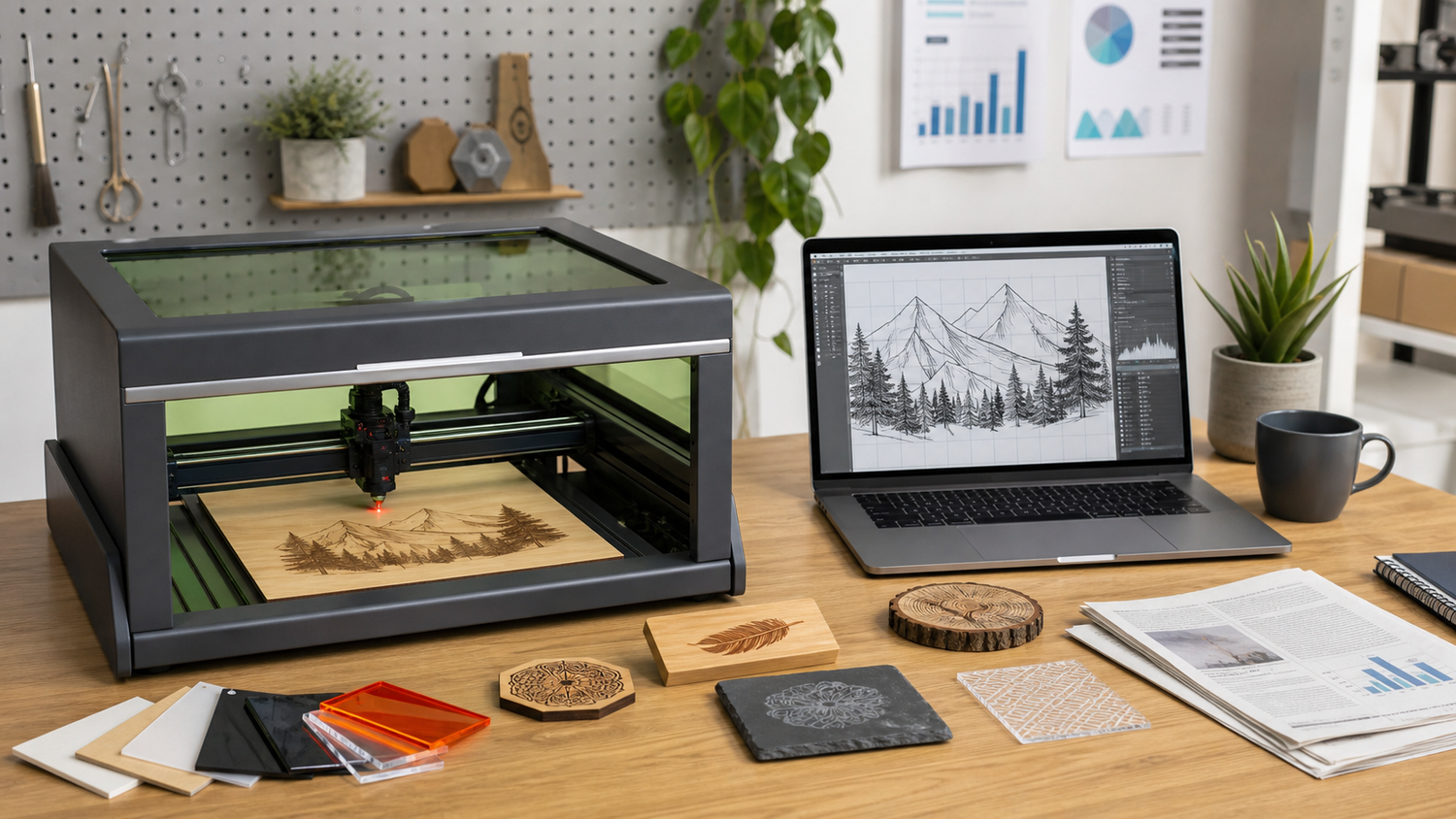
The laser engraving market stayed active in the first half of July 2026, but the momentum was uneven. Software and workflow ecosystems moved fastest, while hardware brands split between product-ecosystem expansion, tutorial-led demand generation, and quieter brand visibility. For buyers and small shops, that matters: the best machine purchase right now is increasingly tied to software support, community settings, and long-term workflow efficiency, not just wattage on a spec sheet.
This roundup focuses on updates visible as of Friday, July 17, 2026 from xTool, LaserPecker, OMTech, Glowforge, GWEIKE, LightBurn, and Kickstarter.
Quick Summary
- xTool / Atomm: Atomm added new Hubs on July 2 and turned Material Lab into a community settings library on July 1, reinforcing xTool's push toward workflow and discovery tools.
- LightBurn: MillMage 0.9 early access landed on July 8 with Pro features like V-Carving, Relief Carving, and True Nesting, showing continued expansion beyond core laser control.
- LaserPecker: The official news feed still highlights the February 28 Design Space Beta (PC 3.0) update as a meaningful software milestone, while creator stories keep emphasizing portability and batch output.
- OMTech: OMTech kept publishing practical buying and upgrade content through July 10-12, a sign it is still competing on education, accessories, and use-case-based search visibility.
- GWEIKE: GWEIKE's recent news positioning remains centered on hybrid and higher-power multi-process systems such as the MCore and M Series.
- Glowforge: Glowforge's official blog still appears quieter than other brands on hard-product news, with the latest visible official posts centered on project inspiration rather than major 2026 launches.
- Kickstarter: Compact and specialty engraver campaigns are still attracting attention, especially around portability, cylindrical engraving, and all-in-one positioning.
xTool Doubles Down on Ecosystem Value
xTool's clearest early-July signal came through Atomm, its project and workflow platform. On July 1, 2026, Atomm said Material Lab had been upgraded into a broader settings library that now supports community submissions, AI material recognition, and filters by machine, laser type, power, and process. On July 2, 2026, Atomm launched themed Hubs that package projects, templates, materials, machines, and tutorials into topic-specific pages.
That may sound like a content play, but it is really a conversion and retention play. Buyers comparing xTool against lower-cost hardware should pay attention to this kind of ecosystem work because it reduces trial-and-error, speeds onboarding, and makes repeat use more likely after the first machine purchase.
Software Is Becoming the Real Competitive Front
LightBurn remains one of the most important neutral platforms in the category. On July 8, 2026, the company announced MillMage 0.9 early access with Pro-oriented features including V-Carving, Relief Carving, and True Nesting. For laser users who also think about CNC-style workflow overlap, that is a meaningful sign that software vendors are trying to own more of the maker and small-shop toolchain.
LaserPecker's official news page still highlights LaserPecker Design Space Beta (PC 3.0), updated on February 28, 2026. That is not a July release, but it remains relevant because LaserPecker's current positioning is clearly tied to making desktop and portable workflows feel more complete in software, not only in hardware form factor.

Buyer takeaway: if your short list includes brands with very different software maturity, compare camera workflow, settings sharing, file prep speed, and community troubleshooting before comparing power numbers alone.
OMTech and GWEIKE Keep Pushing Use Cases, While Glowforge Stays Quieter
OMTech's recent official cadence remains practical and search-oriented. Its news and tutorial pages showed updates on July 10, 2026 around education and maker/STEM use cases, and on July 12, 2026 it surfaced an air-assist upgrade guide. This is classic mid-market positioning: compete through breadth, accessories, and project confidence rather than lifestyle branding alone.
GWEIKE's recent official news feed continues to spotlight hybrid systems. A June 15, 2026 post promoted the GWEIKE MCore as a desktop machine that combines fiber and CO2 capability, while product messaging around the M Series continues to frame bigger-format multi-process production as the next step for serious shops. That tells buyers GWEIKE is leaning hard into workshop consolidation and mixed-material throughput.
Glowforge is the contrast case. Its official blog surface still shows the latest visible posts from June 2025, focused on project inspiration rather than fresh 2026 product announcements. That does not mean the installed base is inactive; the Glowforge community forum still shows active July 2026 discussion. But from a buyer perspective, the public-facing signal is a quieter innovation narrative than what xTool, LightBurn, OMTech, or GWEIKE are presenting right now.
Kickstarter Still Signals Where Demand Is Heading
Kickstarter remains useful as an early demand map even when campaigns are not from established market leaders. Recent live or recent projects continue to cluster around three themes:
- Portability: smaller engravers designed for gifts, labels, and side-hustle personalization.
- Specialization: machines built specifically for tumblers, bottles, and cylindrical objects.
- All-in-one ambition: campaigns that promise broader material coverage or multi-process workflows in a single footprint.
Examples visible this cycle include the Hanboost T1 palm-size laser engraver and VertiGo, a vertical engraver built around cylindrical products. For established brands, these campaigns matter less as direct threats and more as evidence that buyers still respond to highly focused problem-solving.

Buyer-Focused Analysis
- If you are a beginner: software support and settings libraries are becoming more valuable than chasing the cheapest machine with the biggest advertised spec.
- If you run a side hustle: batch workflow, material presets, and fast job setup can matter more than raw cutting power.
- If you sell across many materials: GWEIKE's hybrid messaging and LightBurn's broader workflow expansion are signals worth watching.
- If you mainly make gifts and personalization products: LaserPecker-style portability and Kickstarter-style specialty formats still have strong appeal.
- If you are comparing premium ecosystems: xTool currently looks stronger on visible ecosystem momentum, while Glowforge's public-facing update cadence looks quieter.
Bottom Line
The July 2026 laser engraving story is not just about machines. It is about ecosystems getting stickier. xTool is investing in workflow and discovery. LightBurn is widening its production-software footprint. OMTech is using educational and upgrade content to stay discoverable. GWEIKE is pushing hybrid capability. LaserPecker is still selling the promise of compact, software-assisted production. Glowforge remains relevant, but its public update cadence looks less aggressive than some competitors right now.
For merchants, makers, and buyers, that means the smartest shopping question this month is not simply Which laser has the most power? It is Which ecosystem will save me the most time every week?
Carverall buyer resources
- Explore Carverall laser machines
- Compare laser engraver models
- Read the laser engraver buyer's guide
Sources
- Atomm: Material Lab, upgraded to a Settings Library (July 1, 2026)
- Atomm: Introducing Hubs (July 2, 2026)
- LightBurn: MillMage 0.9 Early Access (July 8, 2026)
- LaserPecker News page, including Design Space Beta (PC 3.0) update
- LaserPecker user story update featuring We Laser Art (updated February 5, 2026)
- OMTech News page (including July 10, 2026 updates)
- OMTech: How to Upgrade Your Laser Engraver with Air Assist (updated July 12, 2026)
- GWEIKE News page, including MCore coverage (June 15, 2026)
- GWEIKE M Series product page
- Glowforge official blog main page
- Kickstarter: Hanboost T1 Palm Size Laser Engraver
- Kickstarter: VertiGo - The Vertical Laser Engraver


